
"To be rooted is perhaps the most important and least recognised need of the human soul."
Simone Weil, 1943, published post-humously 1949.
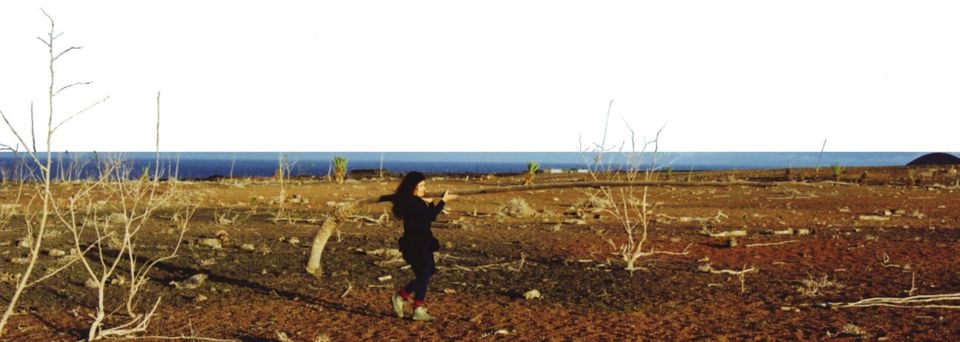
Lanzarote, famous for its striking lunar and volcanic landscapes, lies in the Atlantic Ocean off the northwest coast of Africa. The landmass is a marvel of stark beauty, with sparse vegetation and a raw energy, shaped by fire, wind, and sea into a terrain that feels both ancient and perpetually unfinished. An absence of abundance becomes a kind of eloquence - a landscape that speaks loudly through what it withholds
Rufina Santana has called this island home for decades, closely observing its environment and translating the Canarian landscape into a universal language of myth and symbol. This newsletter turns to her earlier work, revealing a deep and abiding commitment to the natural world, and to the Canary Islands in particular.
Santana’s Garden cycle started in 1990, where she staged an outdoor installation in Tías, Lanzarote, titled Alphabet for an Island, a land-art intervention in which the island's own vegetation became the source material and the alphabet of a new visual language.
Eleven years later, Hespérides: El Jardín Interior, followed. Shown first at the Centro de Arte La Regenta in Las Palmas de Gran Canaria and subsequently at the Sala de Exposiciones La Granja, Santa Cruz de Tenerife, in 2001.
In Greek myth, the Hesperides are nymphs who tend a garden of golden apples at the western edge of the world. Daughters of Atlas in the most widely cited tradition, they guard the tree alongside the immortal dragon Ladon, a gift bestowed by Gaia upon Hera as a wedding offering. The apples became the object of Heracles' Eleventh Labour, one of his most celebrated feats.
Santana weaves this myth into the physical and spiritual landscape of the Canary Islands, long theorised in historical and humanist traditions as the true site of the ancient Garden of the Hesperides. Her work frames the archipelago not merely as a geographical stopping point between worlds, but as a threshold space, charged with mythic resonance and layered meaning.
The solo exhibition Arqueología del Jardín (Archaeology of the Garden), shown across three venues in 2002, the Centro de Arte Juan Ismael and the Centro de Arte Molino de Antigua, both in Fuerteventura, and the Convento de Santo Domingo de Teguise in Lanzarote, represented both a deepening of the Garden theme and, in Santana's own conception, a kind of conclusion to the meditation begun twelve years earlier. The exhibition combined painting with sculptural assemblages made from found branches, roots, and organic materials gathered from the island landscape. The practice Santana describes as ecological rescue, the gathering of fallen, discarded, or weather-worn plant matter, transforms debris into archive. The word archaeology in the title is precise: this is a practice of excavation and recovery, of attending to what the land has shed and reading it as evidence of deeper history.
Santana's ecological commitment positions her practice at the heart of contemporary debates surrounding art's social function. Archaeology of the Garden stands as an act of aesthetic resistance, a quiet but resolute testimony to the possibility of renewal. In gathering the scattered fragments of a shared history, Santana proposes that even within a fractured world, beauty can be reconstituted: patiently, lovingly, and in the restorative silence of the garden reclaimed.
For further information contact:
[email protected]
Newsletter:
Courtesy and Rufina Santana and Renée Pfister Art & Gallery Consultancy 2026.